Ampezzo – Priuso – Mediis
Davanzo’s perspective
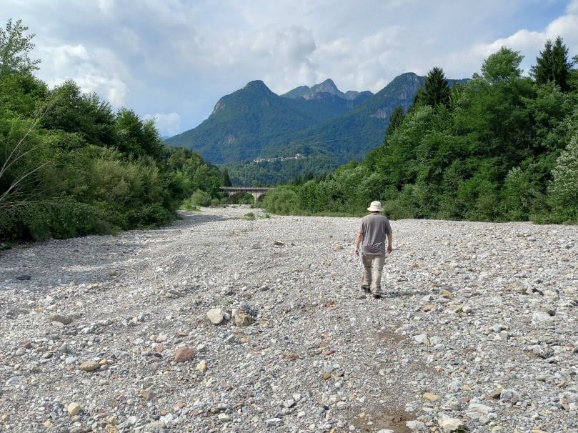
Among the links connecting Ampezzo to Socchieve, the path passing through the localities of Chiamesans and Cjavujgnis was of particular importance. Today, this trail has partially disappeared between the two smaller hamlets. Pending a future restoration, the itinerary has been rerouted to pass through the Fornace area. This detour offers one of the most striking views of Ampezzo, a vista very dear to the painter Marco Davanzo, who loved to retreat here to paint. The route also includes fording the Lumiei stream, which is only passable during dry periods.
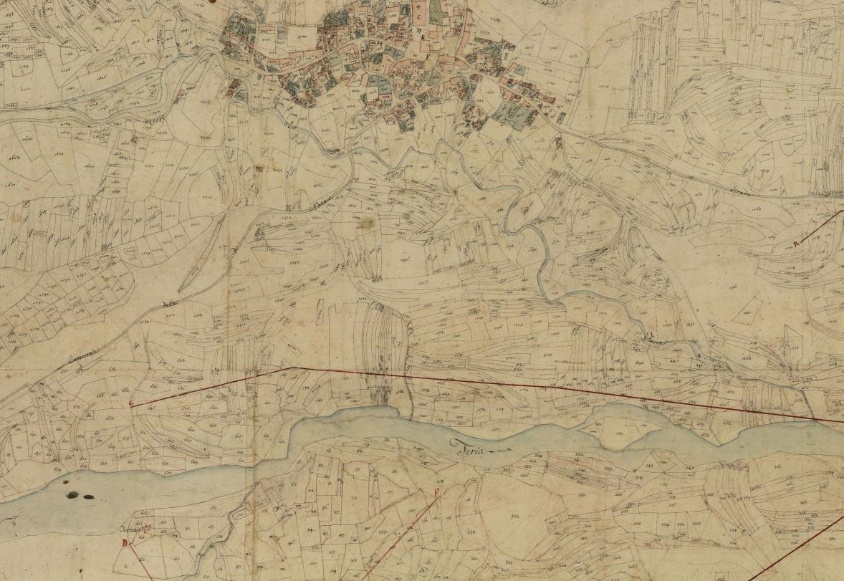
The ancient mule track
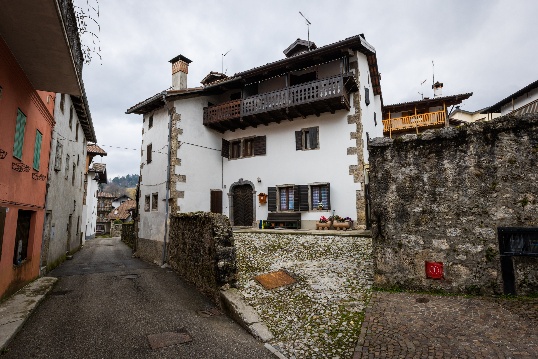
Starting from Ampezzo, you head down through the district of Brazzoletta, which is graced by fine examples of eighteenth-century architecture, most notably the characteristic houses with loggias and galleries. You then gradually enter the vast Teria Valley, where the waters almost seem to vanish among the glacial deposits.
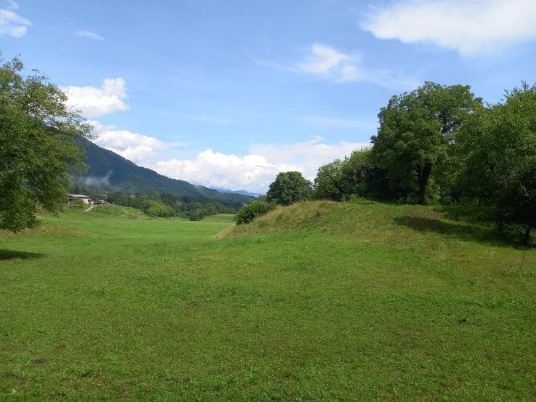
The ancient historic mule track has now been transformed into a narrow paved road: the landscape, once dominated by crops, has given way to meadows where it is not uncommon to see grazing animals. After crossing the small bridge over the Teria, you reach the locality of Fornace. No visible trace remains of the old factory today: in its place stands a farmhouse that, in the nineteenth century, belonged to the Candotto family.
The village of Chiamesans
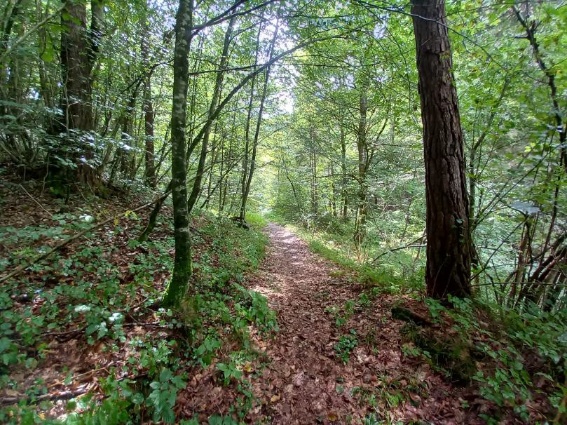
The route continues for a long stretch on asphalt before turning onto a path. This allows you to cross the Gleral stream and follow its course until it rejoins the old mule track to Priuso. Although this section is now deep in the woods, the vegetation still clearly reveals the ancient main road leading to Chiamesans, a village once under the jurisdiction of Priuso.
It was also a favorite subject of Marco Davanzo. From here, the old path has been restored, offering a public pedestrian alternative to the paved road. Once you reach the new state highway, at a slight left-hand curve, take the path that descends gently along the slope of the glacial terrace. Following this main route, you drop down to the ford of the Rio Scanfoç, which is almost always dry, marking the entrance to the Priuso plateaus.
Priuso, a vast autonomous domain
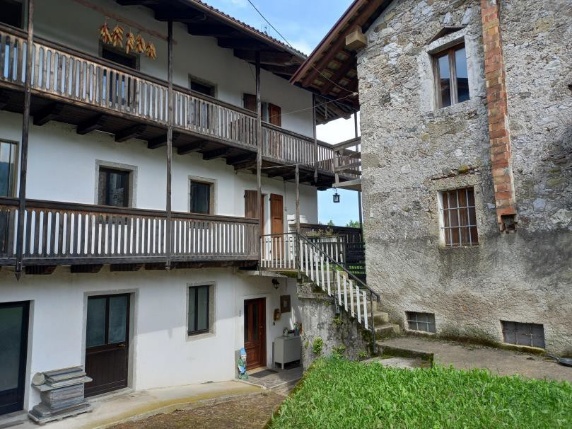
Despite the severe damage suffered during the 1976 earthquake, which deeply scarred the aesthetics of the typical Carnic houses, the village of Priuso preserves its urban layout and the beauty of its church intact. Formerly an independent municipality, Priuso boasted a vast territory extending all the way to the Rest Pass, possessing significant resources for its small population. The connection to Mediis (also once an independent municipality) was relatively short. The two villages shared opposite banks of the Lumiei: the Priuso side, characterized by a river terrace, was particularly suited for agriculture, while the Mediis side rested on conglomerate formations.
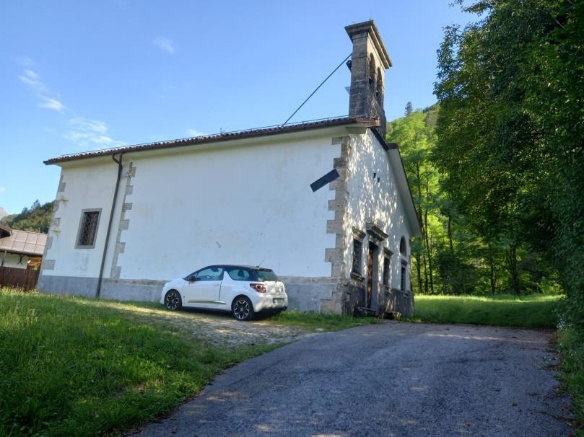
The path led to the riverbed exactly where the Mediis mill stood on the bank of the same name. The structure was vital for both communities, as the other mills in Priuso, located in the Tagliamento valley, were mostly of recent construction. Although the Mediis mill is now a ruin, it is still possible to admire the massive embankment built to protect it from the floods of the Lumiei. You arrive in Mediis by going up the mill road, passing in front of the schools and turning into the alley of the same name, until you reach the church that marks the heart of the village.